History and future of our work
Every generation has its philosopher: a writer or an artist who captures the imagination of an age. Sometimes these philosophers are recognized as such; often it takes generations before the fact is understood. But recognized or not, an age is marked by the people who express its ideals, whether in the whisper of a poem or in the roar of a political movement. Our generation has a philosopher. He is not an artist, nor a professional writer. He is a programmer, Richard Stallman
— Lawrence Lessig[note]Professor of Law, Stanford Law School, founder of Creative Commons. Quoted from his introduction to the book Free Software, Free Society, 2002. [/note]
A bit of history
When, some three decades ago, Richard M. Stallman started the Free Software[note]This text is written for an audience not entirely familiar with the concepts of Free Software, Free Culture, etc.[/note] movement, it was hard to imagine that it would drive the largest collective creation in history — the foundation on which much of the software that makes the Internet possible runs[note]To mention a single Free Software project, in 2013 the Apache server was estimated to be the web server of 54% of all active websites on the Internet[/note], as well as the infrastructure of corporate giants such as Google[note]Google uses its own version of the GNU/Linux operating system for its servers[/note].
But Free Software was only the beginning: its philosophy gave rise to other great collective creations such as Wikipedia, by the Wikimedia Foundation, built on a philosophical, legal and technical foundation inspired by and extrapolated from the Free Software development model[note]The Free Universal Encyclopedia and Learning Resource, Richard Stallman, 1999[/note].
The creation process of Free Software can be explained simply: a group of people with a similar problem coordinate to solve it and take care to share the solution with the rest of the world. In doing so, they try to fulfil one premise: that no one should have to solve the same problem twice.
While one could say this is the basis of all scientific creation, Free Software improves that process through:
- digital tools designed to facilitate that collaboration among people distributed all over the world (such as the collective writing of an encyclopedia in the case of Wikipedia).
- legal tools (licenses) that protect these collective creations and ensure they remain free over time — that is, commons of humanity. This is the case of the license used for Wikipedia’s contents.
In  2001, inspired by the legal tools of Free Software, Creative Commons was born — a legal initiative that has since maintained a set of licenses aimed at any creative work, giving creators a wide range of possibilities to spread and share their work more freely than a normal copyright.
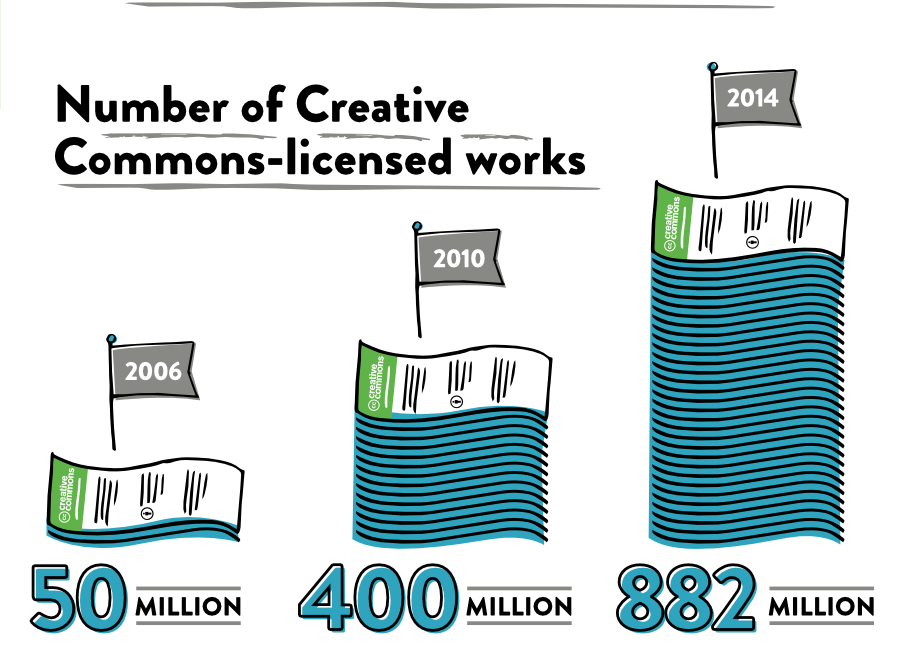
Over all this time, countless artists and creators[note]In 2014, 882 million creative works carried Creative Commons licenses; on Flickr alone, more than 135 million images in 2010 were shared by their authors using these licenses[/note] from many disciplines have published their work using this kind of license, easing its dissemination without intermediaries, derivative works, remix and, in general, Free Culture.
On the other hand, digital tools allow hundreds of thousands of people across the globe to develop, in a coordinated way, works as complex and specialized as Free Software, or to write and maintain free encyclopedias like Wikipedia in many languages and in real time.
Designing and creating tools of this kind facilitates certain processes, just as the design of a building can facilitate some usage dynamics over others.
[pullquote]This environment of free access and creation is an ideal one for solving the challenges of our century[/pullquote]Moreover, by sharing these tools, others (people and institutions) can follow these dynamics without great legal or technical effort, under that premise of not solving the same problem twice.
In short, we all make works derived from others that inspired us before. Quoting Northrop Frye:
Poetry can only be made out of other poems; novels out of other novels
This environment of free and gratis access to Culture and its creative tools generates and facilitates a hyper-creative environment of building upon what others have built before (tools, licenses and contents). Focusing on more practical areas, new problems are solved using what has already been solved as a basis. An ideal environment for solving the challenges of our century.
[pullquote]Like Free Software, Wikipedia has been only a beginning towards a whole distributed free library[/pullquote]This great collective cultural creation, available without artificial barriers (digital, economic or legal) and being the common good of humanity that it is, benefits directly and indirectly even those who do not yet have Internet access[note]As an example of the derivative works and remix that Free Culture enables, there are initiatives that allow offline use of Wikipedia, such as Afripedia or Appropedia, which, using the same software as Wikipedia, builds an encyclopedia of collaborative solutions for sustainability and poverty eradication.[/note] Conversely, another online encyclopedia with an outdated creation and distribution model, such as Microsoft Encarta, ceased publication in 2009[note]http://en.wikipedia.org/wiki/Encarta[/note].
Like Free Software, Wikipedia has been only a beginning. Although we have built and maintained this free encyclopedia, this creative process will not be limited to a single central encyclopedia; rather, there is a whole tendency to collaboratively create an entire distributed and living free library of intellectual, scientific and practical resources, shared by and for everyone.
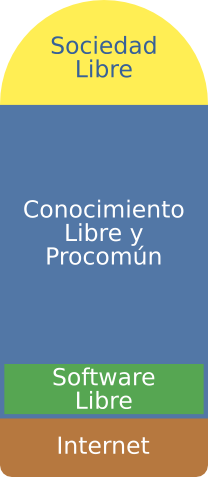
Let us also recall the disappearance of the (central) Library of Alexandria[note]http://en.wikipedia.org/wiki/Library_of_Alexandria#Destruction[/note] and how a distributed model of non-centralized libraries makes our cultural heritage safer and more resilient over time.
To achieve this, we need tools to build and preserve, together, this complete and distributed “network of libraries”: a distributed and free ecosystem of creators, resources, methods, designs, tools and knowledge that can make a Free Society possible.
Our history
[pullquote]How can new technologies be used to facilitate collaboration among people with shared interests and problems?[/pullquote]In 1999 we asked ourselves the following question: how can new technologies be used to facilitate collaboration among people with shared interests and problems? We sensed that if the network made it possible to create something as complex as Free Software, it should be possible to imitate similar working dynamics in other areas.
Or, put from a technical perspective: if there are large Free Software factories[note]Formerly SourceForge or Savannah, now GitHub[/note], what would a Free Culture factory look like?
ourproject.org
In 2002 we started ourproject.org, with the goal of creating digital collaboration tools for any area. In other words, our mission is to bring the creative philosophy of Free Software to other fields — such as international cooperation, education, creation or ecology — radically fostering peer collaboration and making it easy for people to share their work with the rest of the world.
[pullquote]Our mission is to bring the creative philosophy of Free Software to other fields by creating Free Culture factories[/pullquote]When, at the end of 2002, Creative Commons published its first version of licenses, we made them available to our projects and users. Until then, we used licenses such as the pioneering Free Art License (from 2000), created by artists and jurists within the French collective artlibre.org.
Creative Commons saved us a great legal effort by sharing its legal tools: having its licenses adapted to different countries and languages allowed us to share our projects in different ways (allowing commercial use or not, derivative works, etc.) and in different contexts.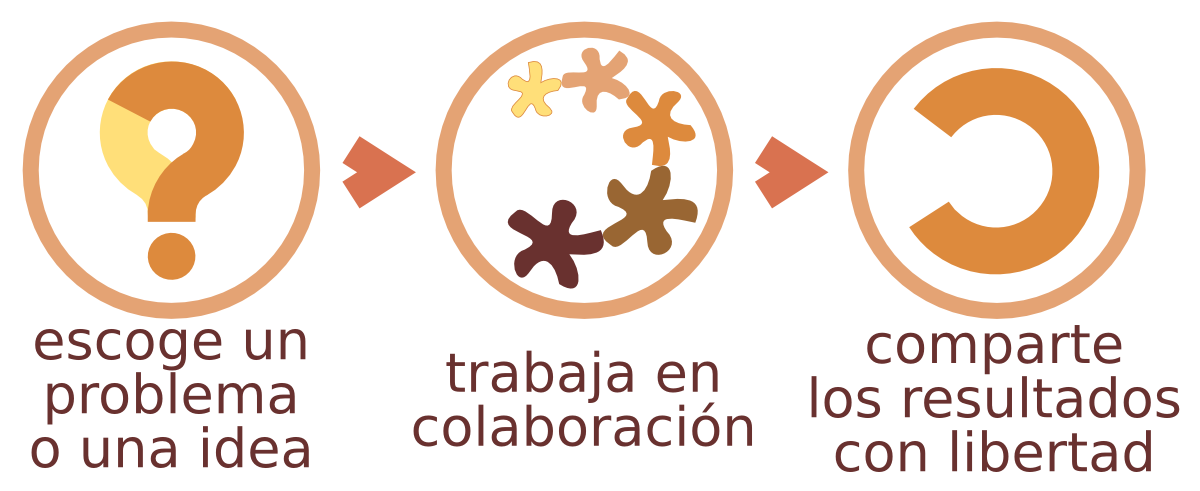
In the same way, we share our digital tools and our space on the Internet in exchange for the initiatives we host sharing their work under these free licenses — that is, with everyone — thus making the contents (the projects) belong to all of us, ours, without excluding anyone.
In other words, our initiatives fall within the so-called gift economy.
kune
[pullquote]kune is a new development of web tools with the same goals[/pullquote]Thanks to the advance of web technologies and the experience accumulated at ourproject.org, we decided[note]http://homes.ourproject.org/~vjrj/blog/2005/12/09/hacia-un-nuevo-gestor-de-proyectos-libres/[/note] to develop a new set of web tools with the same goals, seeking to modernize ourproject.org. Thus, in 2007, our software kune was born — which means “together” in Esperanto — and a few years later our service kune.cc.
What is kune? Compared with tools from corporations such as Yahoo, Google or Facebook, kune is a social network that shares with its users and collectives a set of web tools equivalent to Yahoo or Google groups, to Google Docs collaborative documents, to Google calendars, to the Facebook social network (Forbes magazine, among others, mentions us as an alternative to Facebook), to make some comparison — but with the difference that our tools are oriented towards Free Culture and collaboration.
Our software kune is decentralized, unlike other social networks such as Google+ or Facebook. Just as, in an email service, a user can choose among different mail providers (gmail, hotmail, yahoo, …), a user can choose among different kune providers and thus avoid the centralization of personal data and contents.
Our service kune.cc is just one more node in that decentralized collaboration social network, that distributed network of libraries that uses our software kune. In this same sense, an institution (a university, a company, an association, etc.) can maintain an independent kune node (just as it can maintain an email server).
Projects and initiatives we support
Over all these years, we have hosted and supported with our tools projects from very diverse areas (art, ecology, education, science, history, immigration, political science, press, radio, health, …), in many countries and languages[note]kune is currently translated into more than fifteen languages[/note] and many kinds of groups (NGOs, associations, social collectives, universities, …), to name only a few.
All these initiatives have chosen our cultural space as their digital “home” for its independence from commercial platforms, for being free of advertising, for its collaborative approach, and for our commitment to freedom of expression and Free Culture.
If we compared ourproject.org or kune.cc to a cultural center, it would be one where its resources are shared with a multitude of projects and initiatives that could use them to develop, meet, make themselves known and share their work with everyone who visits, while opening themselves up to new collaborations and relationships.
Comunes Association
[pullquote]We share our hardware, our collaborative software, our Internet connection and our electricity, with thousands of free projects that fill it with free, living and multicultural content[/pullquote]The Comunes Association is a Spanish non-profit association dedicated to the development of these digital tools and spaces, with the goal of fostering the Commons.
We also support other initiatives that likewise foster Free Culture and the Commons, both digital and material (seed-exchange networks, communal forest management, etc.).
Our digital spaces ourproject.org and kune.cc have their own hosting, which hosts thousands of users and projects. That is, we share our hardware, our collaborative software, our Internet connection and our electricity, with thousands of free projects that fill it with free, living and multicultural content.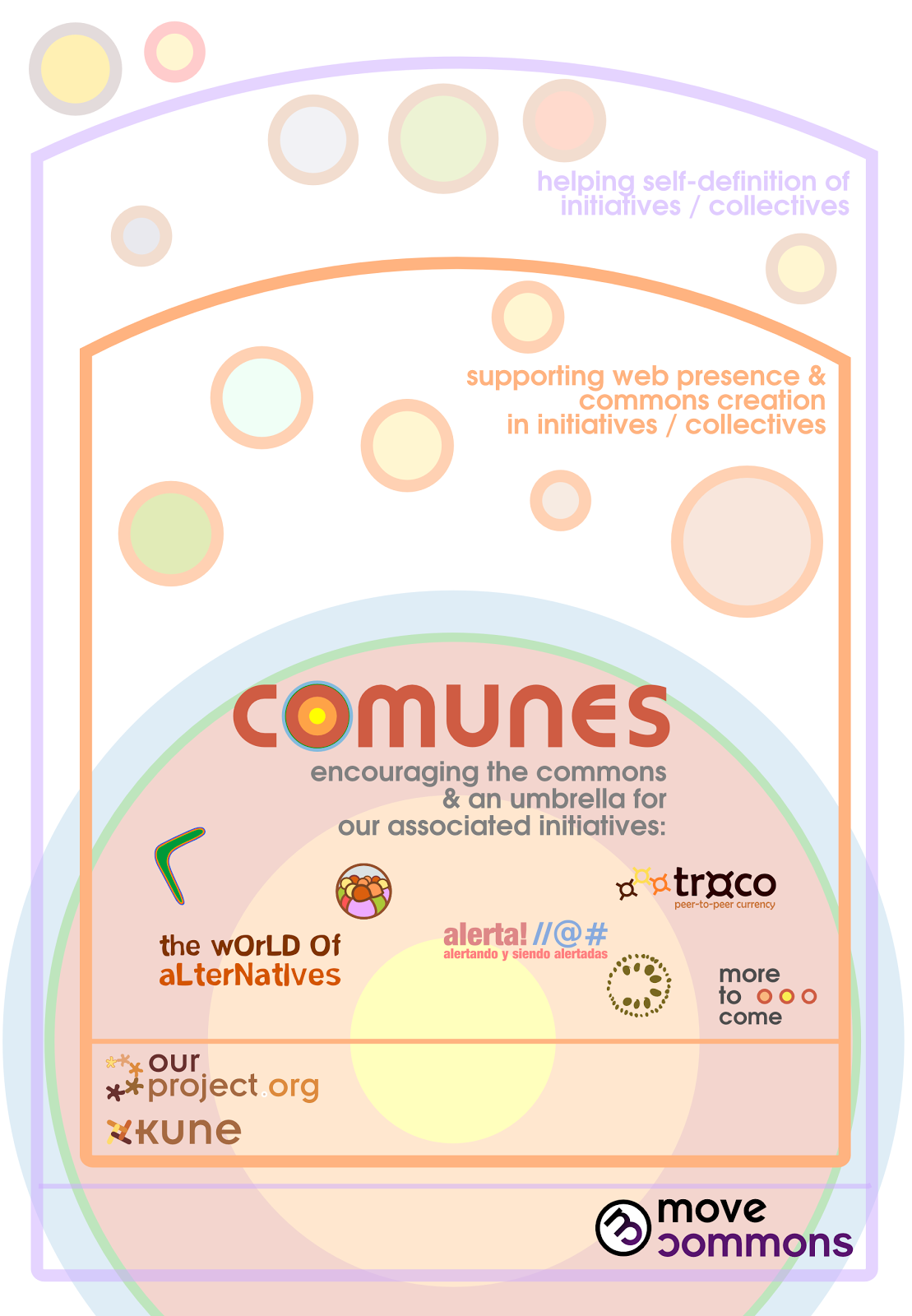
Like all infrastructure, it requires a minimum of maintenance. But we are more interested in a distributed model than a centralized one, so we make it easy for any institution to maintain similar spaces and form that network of distributed free libraries, that network of distributed cultural centers with shared interests.
So far our software has been used by local governments, universities, corporations, NGOs (such as the International Forum on Democracy and Cooperation promoted by the IEPALA Foundation), other associations and organizations. Developing novel tools of this kind has also allowed us to establish agreements with universities to foster the learning of young developers.
We seek more support
[pullquote]Supporting us is supporting all the initiatives we host and that use our spaces, as well as other organizations that we help to have similar spaces[/pullquote]Non-profit experiences like ours, or others such as Wikipedia, that seek to foster Free Culture, have a funding model based on donations, whether individual or from entities. It is a funding model with a long history of commitment to initiatives of social interest, which guarantees great independence.
Over all these years we have maintained our services thanks to small donations and personal contributions, avoiding other for-profit models, such as free services that use advertising and/or trade your personal data.
In the current context of crisis, these personal donations have decreased greatly, so we are looking for collaborating members and entities that share our philosophy and can help us maintain and strengthen our activity.
The current crisis has made the existence of free, gratis and common spaces even more important — for initiatives that could not access the same services if they were paid, or that would not want to if they were for-profit services. Connecting these initiatives to the network is contributing to the diversity of voices and perspectives that digital culture can and must continue to provide.
Supporting us is supporting all the initiatives we host and that use our spaces, as well as other organizations that we help to have similar spaces.